
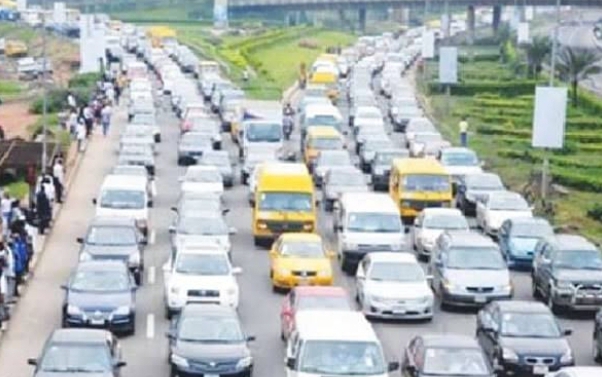
Every single morning, millions of Lagosians ask the same question, “how long would it take me to get there?” The question reveals that the problem is not where to get to or how to get there, rather a question of how long traffic on the road is going to last.
Traffic has therefore become an inevitable part of the city, so much so that people plan their movement around it.It has been a long standing problem, but this should not be mistaken for inaction by the state government. In fact, Lagos has been anything but stagnant in its response. Roads have been expanded and rehabilitated. Bridges constructed.
Newer systems such as the Bus Rapid Transit system, introduced and more recently, the state’s rail network has expanded with the introduction of the Blue and Red lines. Simultaneously, traffic management agencies continue to regulate movement, while the government has introduced measures targeting parking, commercial vehicles and traffic violations.
Despite the continuous expansion of infrastructure and interventions, why does congestion remain such a persistent challenge of Lagos?
The answer might seem straightforward; population, upon closer assessment however it can be more complicated than the size of the city’s population.The population growth does not, by itself, explain why some roads become almost immovable at particular times or why congestion can persist despite the construction of new transport infrastructure.
A 2024 study examining traffic congestion in Lagos identified several contributing factors, and although it included population growth, other factors such as poor road conditions, peak-period traffic, driving behaviour and inadequate transport policies were also on the list. This suggests that the city’s congestion is not the product of a single problem. The distinction is important.People do not simply contribute to traffic because they exist.
They contribute because they have places to go.In other words, Lagos does not merely have a population problem. It has a movement problem one that has been attempted to address in various ways. One of such attempts is the development of rail transportation.
It represents one of the most significant attempts to reduce Lagos’ dependence on its roads. The Red Line, a rail corridor spanning 37-kilometres with 13 stations, was designed to provide an alternative to road transportation and improve movement across some of the city’s busiest corridors.
Similarly, the Blue Line has introduced rail transportation along another major axis of the city. For commuters who can conveniently access them, these systems offer something roads cannot; comfort and time.
The Bus Rapid Transit (BRT) system has served a similar purpose. Rather than simply increasing the number of roads, BRT attempts to increase the number of people that can be transported through existing corridors.
But infrastructure only works according to how it is used.A railway station can exist without serving residents who live close to it.
A bus system can convey hundreds of people while still suffering from congestion on the road and a new bridge can improve movement in one direction, yet, shift the pressure onto another road.This explains why Lagos’ traffic persists despite billions spent.
More infrastructure does not translate to the disappearance of the problem.There are also other problems that contribute to this, one of the major ones being parking.
It is not uncommon to find vehicles occupying road space on roads, medians and other public pathways in Lagos.
This often reduces the effective capacity of roads, particularly in commercial areas where such informal parking occurs. The government has not been silent about this either, the Lagos State Parking Authority has pursued measures to improve parking management, including proposed on-street parking schemes in areas such as Ikoyi, Victoria Island, Ikeja and Surulere.
In the same vein, LASTMA officers are a familiar presence on Lagos roads, directing traffic, responding to accidents and attempting to keep vehicles moving at difficult intersections. In 2025, the state also relaunched its Special Traffic Mayor initiative, involving government officials and stakeholders in traffic management and public participation.
However, enforcement comes with its own challenge; the response of Lagosians to the rules designed to ease movement?Traffic regulations can only go as far as the adherence of those it is meant to govern.
A familiar scene on Lagos’ roads involve Illegal parking, driving against traffic, obstruction of roads, indiscriminate loading and unloading and other forms of non-compliance can contribute to congestion.
Here, the problem of traffic extends beyond bad roads or poor infrastructure, it becomes the issue of the public.It is important to note that the city, being a commercial hub, passenger transportation is not the only form of movement taking place. Trucks transporting goods compete for road space with buses, cars and other vehicles.
The Apapa and Lekki port corridors demonstrate this particularly well. The movement of cargo creates an entirely different kind of traffic pressure.
The state has consequently introduced systems such as the truck E-Call-Up system to regulate the movement of articulated vehicles around the ports, while enforcement has continued to evolve in response to congestion and non-compliance.
Yet the problem persists.As Lagos continues to grow, new residential developments create new commuter routes. Businesses relocate and expand, commercial centres attract people from different parts of the city.
These new developments create additional demand for those roads.A road constructed to solve today’s congestion problem, might not be sufficient years later, demonstrating why infrastructure alone cannot be the entire solution.
Billions of Naira and multiple reforms later, yet traffic remains tied to the country, therefore, Lagos has to consider not only how people move, but also where they live, where they work, where businesses are located and how different forms of transportation interact.