
Co written and edited by Hadizat Giwa
Before motorcycles became Lagos’s transportation backbone, residents relied on taxis, mini-buses, the wooden lorries known as bolekaja, and the state-operated bus service. Commercial motorcycle transport barely existed in Nigeria before the 1970s.
According to Eko Akete, the business emerged in Yola around 1970 and spread across the country through the following decade.In Lagos specifically, the cause was straightforward which was rapid population growth had outpaced the city’s transport infrastructure.
As the mass transit system and municipal buses collapsed under demand, motorcycles filled the void. The business proved lucrative, operators earned between ₦1,000 and ₦3,000 daily, enough to draw artisans away from their trades and migrants from other regions seeking steady income.This explosive growth came with serious consequences. According to Eko Akete’s 2013 report, motorcycles had become tools of choice for armed robbers, kidnappers, and other criminals.
The report cited claims that more than 70 percent of crimes in Lagos at that time were connected to bandits operating on motorcycles, from phone and bag snatching to abduction and assault, often occurring at dawn or late at night when unsuspecting passengers flagged down bikes. Lagos’s orthopaedic hospitals filled with victims of reckless riders.
The Oba of Lagos, Rilwan Akiolu, did not mince words, describing Okada as “a symbol of poverty.” Other states like Rivers, Delta, Enugu had already moved to ban commercial motorcycles with minimal resistance.
Lagos attempted a more measured approach first: mandating helmets, limiting passengers to one per bike, and prohibiting pregnant women from riding. When these restrictions failed to change behavior, the state escalated to stricter traffic laws, setting the stage for prolonged conflict.
The timeline that followed was relentless. Back in 2005, Tinubu first floated a ban. Then in 2012, there was a new traffic law that blocked Okada from certain major roads. The same restriction that sparked the 2013 standoff Eko Akete documented. Riders challenged the ban in court and lost. But the fight continued to escalate.Things got serious in 2018.
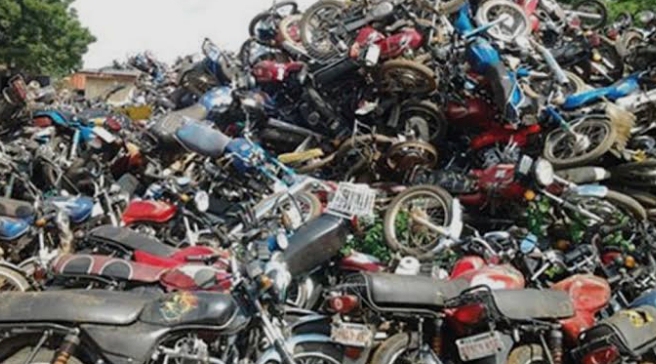
The Lagos State Transport Sector Reform Law came down hard: riding a motorcycle on a major highway became a criminal offence with up to three years in prison and your bike getting seized. By February 2020, the government banned Okada completely in six local government areas and nine council development areas. Then in mid-2022, they tightened it even more.
More than a decade after the initial conflict, the core tension remains unresolved. The strongest argument of the proponents of the continued restriction on commercial motorcycles in Lagos is the seemingly intertwined relationship commercial motorcycle operations and criminal activities.
Although it would be unfair to label every okada rider as a criminal, repeated security operations by the Lagos State Task Force, the Kick Against Indiscipline (KAI) Corps and the Lagos State Traffic Management Authority (LASTMA) have highlighted how commercial motorcycles are frequently used by criminal elements to evade law enforcement and facilitate crimes. This has even led to the classification of these agencies during operations as a part of “criminal elements”. This concern is not based solely on perception.
When Lagos first expanded restrictions on commercial motorcycles in 2020 and reinforced them in 2022, the state government cited the motorcycles posing security risks as a major justification for the policy. Government officials argued that the restrictions were intended not only to improve road safety but also to curb insecurity by limiting the mobility of criminal gangs operating in densely populated parts of the state.
More recently, the Lagos State Task Force has repeatedly stated that enforcement operations on restricted routes are designed to strengthen public safety and prevent criminal activities, noting that several locations targeted for raids had generated complaints linking illegal motorcycle operations to robbery and other security threats.
All of these arguments by the governments have been backed by some of the general public and viewed as improper by others. Members of the public understand the risks of Okadas, and therefore stand in support of the government’s decision, while the others have a different perspective of the matter.
The strongest argument of those who support the retainment of okada is that it is a very common means of livelihood and its ban means stripping many of their means of livelihood. They further argue that the government is not providing a replacement for them.
Of course, the government is aware that not every commercial rider is complicit in crime and that thousands depend on the business for their livelihoods and provide an essential transport service, particularly in underserved communities.
However, broader security implications must be considered when a mode of transport becomes consistently associated with criminal escape, rapid movement and evasion of law enforcement.
The challenge before the state, is therefore, to strike a balance between protecting legitimate livelihoods and safeguarding public safety. Ultimately, the debate should not revolve around whether all okada riders are criminals, that is never the case in any of such situations.
Rather, the question should be whether the security risks posed by the persistent misuse of commercial motorcycles are significant enough to justify maintaining restrictions while the state expands safer and more regulated alternatives for commuters.
 Hadizat Giwa