
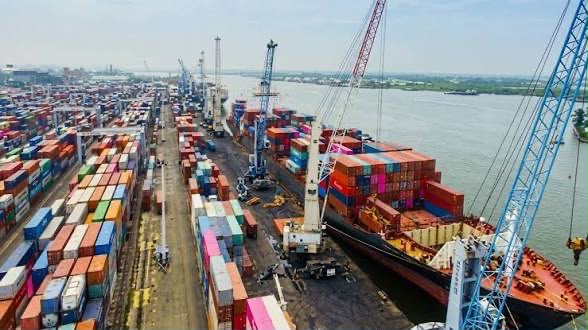
The Federal Government has begun exclusive negotiations with APM Terminals over the proposed Badagry Deep-Seaport in Lagos State, the Minister of Marine and Blue Economy, Adegboyega Oyetola, announced on Tuesday.
Oyetola disclosed the development in a post on his X account, saying the talks followed the signing of a Memorandum of Understanding with Badagry Port Development Limited after discussions with APM Terminals in Copenhagen, Denmark.
The agreement gives the company exclusive rights to negotiate the project’s development.
“Yesterday in Copenhagen, Denmark, we took an important step towards unlocking a new chapter in Nigeria’s maritime and economic development,” Oyetola said, adding that he had led a Federal Government delegation to engage APM Terminals on the project.
The proposed seaport is expected to expand Nigeria’s deepwater capacity, allow larger container vessels to call at the country’s ports, and increase opportunities for cargo handling and transshipment serving Nigeria and the wider West African market.
Oyetola said the project aligns with the government’s broader strategy of attracting private-sector investment through public-private partnerships, and is expected to support jobs and enterprise across the maritime value chain, including logistics, manufacturing and warehousing.
The Badagry project is part of a wider effort to expand deep-sea port capacity along Nigeria’s coastline, with similar developments under consideration in Akwa Ibom, Bayelsa, Cross River, Ogun, Ondo and Rivers states.
According to the minister’s statement, the government is also working to modernise existing port infrastructure, with the Nigerian Ports Authority prioritising rehabilitation of the Apapa and Tin Can Island ports, support for the Lekki and Badagry ports, revitalisation of ports in the east, and the rollout of digital systems such as the Port Community System and National Single Window.
The announcement comes as Nigerian ports report increased activity this year.
Cargo throughput rose 11.6% year-on-year in the first quarter to 32.38 million metric tonnes, while the gross registered tonnage of ocean-going vessels increased 19.5% to 46.75 million tonnes.
In the second quarter, cargo throughput grew 12.3% to 35.74 million metric tonnes, vessel calls rose 14.4% to 1,201, and container traffic increased 11.3% to 602,392 twenty-foot equivalent units. Transshipment volume reached 29,038 TEUs, compared with none recorded in the same period last year.
The gains follow a strong 2025, when total cargo throughput rose 24.8% to 129.3 million metric tonnes and container traffic increased 25.7% to more than 2.1 million TEUs.Separately, the government has moved to improve financing for local participation in the maritime sector through the Cabotage Vessel Financing Fund, more than two decades after it was established.
President Bola Tinubu has approved disbursement of the fund, with Oyetola directing the Nigerian Maritime Administration and Safety Agency and 12 primary lending institutions to fast-track the process. NIMASA said it had received 92 applications, with 20 submitted for consideration and one already reviewed and forwarded.
The fund, which offers low-interest, long-term financing to eligible maritime operators, is expected to create more than 30,000 jobs. It was valued at about N44.64 billion when established in 2019; NIMASA estimated its worth at roughly $700 million in 2025.
 Hadizat Giwa